

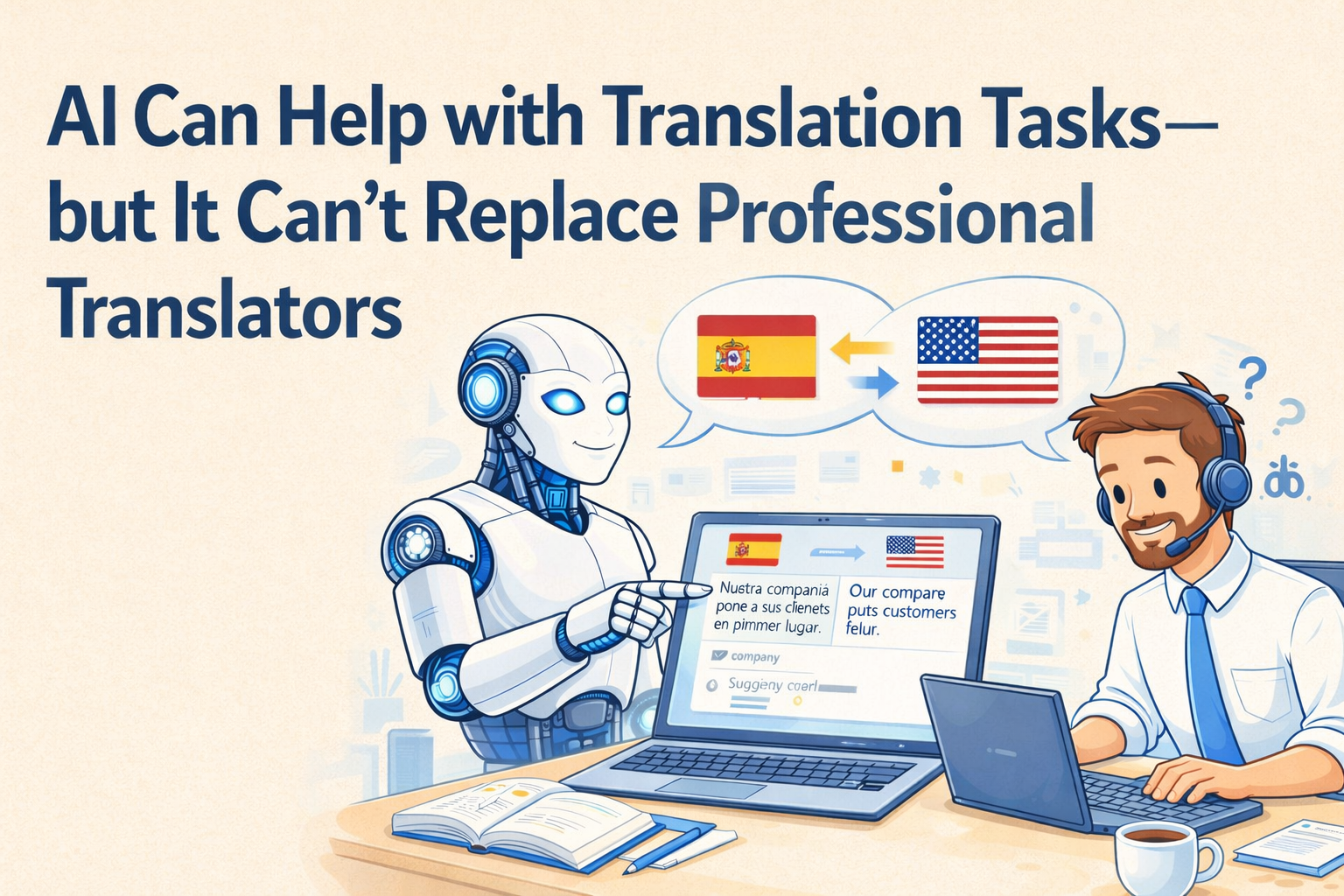
AI Can Help with Translation Tasks—but It Can’t Replace Professional Translators
Artificial Intelligence (AI) tools are quickly improving and becoming more ingrained in daily life—this is especially true for those in the translation industry. But fast doesn’t always equate to good, and while machine translation can speed up some tasks, human translators are essential to communicating nuance, culture, and context.
AI Supplies Efficiency; Humans Bring Expertise
There’s no denying the speed of AI translation tools—AI can translate thousands of words in seconds, while human translators may only translate a few thousand words in a day. This is great for expediting drafts and workflows, but automation doesn’t equal elimination. As Darrell West, a senior fellow in the Center for Technology Innovation at the Brookings Institution, told the American Translator Association (ATA):
“There may not be that many whole jobs that get eliminated. There certainly are going to be a lot of tasks that are going to be eliminated.”
Although AI tools can produce translations in the snap of your fingers, professional translators still play a valuable role in ensuring the accuracy, intent, and meaning of a message is conveyed—after all, translation isn’t transcription.
AI excels at providing quick approximations, which works well for basic communication, but professional translators ensure precision and accuracy every time, which is essential in fields like medicine, law, and finance, where a mistake can affect health, compliance, and risk.
Why Human Translators Still Matter
AI is handling more routine translation tasks, which allows translators to focus their time and energy on the more creative and complex aspects of translation.
Human vs. Machine Translation
Human translators, like those working for the best translation services, view not just words, but their intent and the context in which they’re used. Rather than making a literal (word-for-word) translation, they work to communicate the ideas, meaning, and tone of the message—ensuring it’s both accurate and feels natural in the target language.
Conversely, machine translations use patterns and algorithms to analyze text and predict the likely equivalent in another language. AI translation tools are fast, but often fail to capture distinctions, like cultural subtleties, industry-specific expertise, and tone. The best human translators add:
- Cultural Understanding: Professional translation isn’t just about saying the right words—it’s about conveying the right message, in the right way, for the right audience. Experienced translators ensure everything from accuracy to cultural and brand alignment. Ultimately, they play a vital role in refining AI translation.
- Industry-Specific Expertise: AI struggles to translate the complex terminology and specialized language found in fields ranging from medicine to law to technology. Here, once again, human translators with industry-specific knowledge are critical to ensuring accurate communication.
- Tone: It’s important to consider the old saying, it’s not what you say, but how you say it, when thinking of the role of human translators. Whether delivering a marketing message or a medical diagnosis, human translators are essential for making sure a message is delivered in the appropriate manner and mood.
In the end, AI translation tools can speed up workflows, but professional translators still play a significant role in editing and proofreading to guarantee the proper message is delivered.
AI Is Fast, But Language Is Faster
While AI translation tools move fast, language never slows down. New words and expressions are consistently added to the lexicon. In 2024 alone, Merriam-Webster.com added 200 new words and definitions, including:
- International Bitterness Unit (IBU): a technical term used to measure the concentration of bitter compounds in hops, indicating a beer’s bitterness.
- Burrata: a food made of mozzarella formed into a ball-shaped casing containing curds and cream.
- Touch Grass: a popular social media saying used to remind people to step away from the internet and connect with the real world.
These are just additions to the English language; think about all the changes occurring in the over 7,100 languages spoken worldwide. Human translators help keep communications current.
The Risk of Over-Relying on AI
AI is excellent for boosting productivity, but it isn’t a replacement for human translators. There are a number of ways AI translation tools can put your organization at risk, including:
- Data leaks and cybersecurity breaches
- Unauthorized data sharing
- Intellectual property loss
- Regulatory and compliance violations
- Legal liability and exposure
AI can translate quickly and at scale, but that same power can make mistakes more visible and widespread. Expert translators remain essential for adapting tone, ensuring accuracy, and safeguarding against errors.
A Productive Partnership
The pros and cons of AI translation are well documented—AI isn’t a replacement for professional translation services; rather, it’s a tool that allows them to delegate routine tasks and focus their attention where it’s most valuable.
AI and human translators are partners, with AI bringing speed and scale while expert translators provide specific knowledge, depth, and understanding. They can also work with the client to clarify ambiguities to deliver precise, trustworthy translations to high-stakes communications.
Translations ABC
Famed MIT economist Daron Acemoglu says, “There is pretty much nothing that humans do as a meaningful occupation that generative AI can now do. So in almost everything, it can at best help humans, and at worst, not even do that.”
Don’t trust your valuable communications to sub-par AI tools; rather, turn to the experts at Translations ABC. For 35+ years, we’ve been helping clients in sectors running from government to business to tech choose their words wisely. With a 97% client retention rate, we deliver the human touch that keeps clients coming back year after year, project after project.