

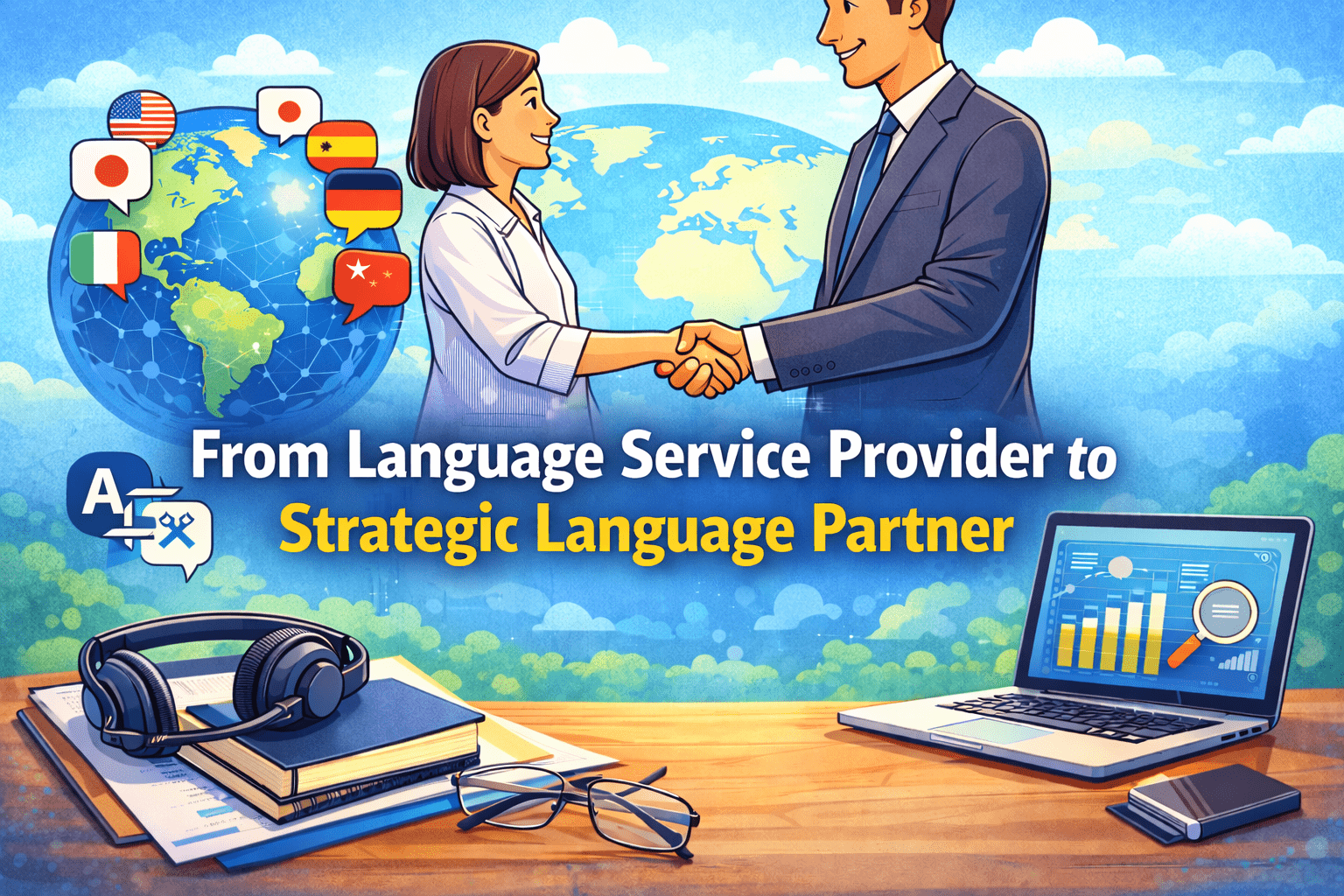
From Language Service Provider to Strategic Language Partner
For years, language service providers (LSPs) were judged primarily on speed, cost, and output. How quickly could content be translated? How low could the per-word rate go? How many languages could be covered simultaneously? Today, that model no longer reflects how global content truly works.
As global communication has grown more complex, the role of translators has shifted from simple execution to oversight, quality control, and strategic guidance. Translation itself is no longer the starting point—it has become the final step in a broader content and communication strategy.
This shift has given rise to a new role: the Strategic Language Partner (SLP).
Strategic Language Partner—More Than a Name Change
The transformation from LSP to SLP is not just a rebrand; it reflects a deeper evolution in the role of language experts. Today’s SLPs bring more than linguistic skill—they combine industry knowledge, cultural expertise, and operational insight to help organizations navigate global content challenges.
Key capabilities include:
- Collaboration
- Communication
- Critical thinking
- Leadership
- Listening
- Problem-solving
- Strategic thinking
In this model, translation remains essential, but it is guided by strategic planning and quality oversight. SLPs focus on delivering measurable outcomes—achieving business objectives, protecting brand identity, and engaging audiences—rather than simply delivering words on a page.
Translation as Craft, Not Commodity
At its highest level, human translation is not a commodity—it is a craft. A well-executed translation resembles a bespoke suit more than an off-the-rack garment. It is measured, cut, and refined specifically for its wearer. It accounts for fit, context, nuance, and intent—not just basic dimensions. Likewise, a crafted translation reflects a deep understanding of the client’s voice, audience, industry, and objectives.
Where standardized translation aims for adequacy, crafted translation aims for precision, tone, and impact. It captures what is meant, not just what is said.
This craftsmanship is what elevates translation from a transactional service to a strategic asset.
Translation Is the Work, Not the Strategy
Translation has not disappeared. For many organizations, it remains a core operational requirement. But it is no longer the starting point. Instead of being embedded at every stage of content creation, translation now follows clearly defined goals, messaging frameworks, and workflow planning. In this approach, translation becomes a strategic checkpoint, with SLPs helping clients to:
- Ensure quality, consistency, and compliance
- Mitigate risk in global communications
- Preserve brand voice across markets
By positioning translation at the end of a well-designed process, organizations streamline workflows, reduce rework, and maintain clarity and coherence across languages—all while working with a language partner who understands their organization, industry, and terminology.
What a Strategic Language Partner Actually Does
SLPs do more than deliver translations—they help build and manage the infrastructure that makes global content effective, including:
- Designing language workflows across teams and departments
- Ensuring culturally adapted, market-ready content
- Scaling content across formats such as text, video, and audio
- Maintaining compliance and quality standards
In other words, translation becomes the final quality filter—applying linguistic and cultural expertise where it is most impactful to ensure content meets brand, legal, and audience expectations after strategic planning is complete.
From Translators to Managers—and Master Craftspeople
The evolution from LSP to SLP also changes how value is measured. Volume and speed alone no longer capture the full impact. SLPs manage complex workflows, coordinate across stakeholders, and ensure consistency and accountability at every stage of the content lifecycle.
At the same time, they safeguard the craftsmanship of translation itself—ensuring that language is handled with care, intention, and respect for nuance.
As many organizations have learned, relying solely on AI, automated, or unmanaged processes introduces risks such as:
- Diluted brand voice
- Cultural misalignment
- Terminology inconsistencies
- Costly editing and rework
Human-centered, strategically managed translation ensures judgment, nuance, and responsibility remain at the core of global communication. In regulated industries such as healthcare, law, and finance—and for any organization handling sensitive information—this oversight is not optional; it is essential.
Reassessing Language Service Providers
While the speed and scalability of automation are appealing, many organizations are finding that these tools fall short in delivering the craftsmanship, accountability, and strategic alignment provided by leading translation partners. Translation is no longer a standalone service—it is a final quality assurance function that validates and refines content produced through a deliberately managed process.
Moreover, machine-generated translations often lack the artistry and judgment inherent in human expertise. In practice, many organizations are discovering that editing and reworking automated output is more time-consuming—and ultimately more costly—than engaging a skilled translator to craft the content correctly from the outset.
The best translation agencies and Strategic Language Partners, like Translations ABC, take ownership of outcomes—helping clients streamline workflows, protect brand voice, and deliver language that fits as precisely as a tailored garment.
Translations ABC
For over 35 years, Translations ABC has been a trusted partner for businesses communicating globally. While tools and processes evolve, our commitment to clients remains unchanged—reflected in our 97% client retention rate.|
By putting strategy first and translation last, Strategic Language Partners ensure human expertise drives clear, culturally accurate, and impactful global content—carefully crafted, not mass-produced.