

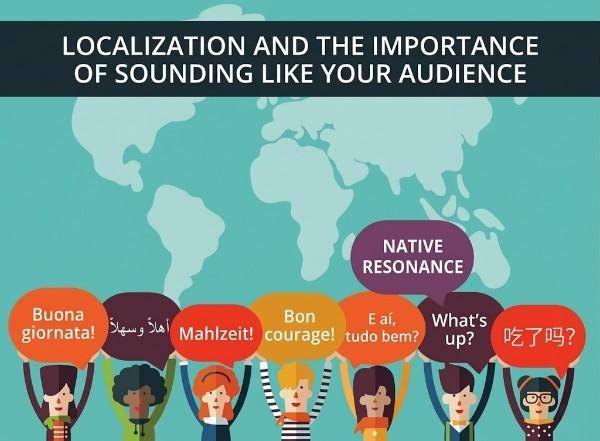
Localization and the Importance of Sounding Like Your Audience
It’s harder than ever to connect with your target audience—automation and the rise in noise are part of the reason. Consider this: it’s estimated that a person in the U.S. is exposed to as many as 5,000 ads per day. Despite the massive amount of messaging individuals are bombarded with daily, only a small percentage of them—fewer than 100—register.
One way to stand out in a crowded global marketplace flooded with AI-driven content is to ensure your message sounds like your audience—featuring a familiar, human-sounding, culturally aware voice delivered through expert translation.
Localization: The Importance of Sounding Like Your Audience
In cross-cultural communication, it’s rarely what you say that determines success; it’s how you say it. Today’s global audiences expect content that speaks directly to them, reflecting their language, values, and cultural nuances. When that connection is missing, the consequences are measurable: eroded trust, reputational risk, and missed opportunities.
Transcreation, the process of adapting content across languages while preserving intent, tone, emotion, and cultural context, has become a critical business imperative. Beyond its well-established role in branding, advertising, and marketing communications, localization is increasingly essential to protecting brand equity and driving global growth. It ensures that every message resonates with the audiences that matter most—whether it’s a marketing campaign, educational materials, instructions, presentations, or official communications.
Recently, there’s been a lot of interest in how AI is changing the translation industry, reducing project times and lowering expenses. However, many overlook the cost of AI, which can greatly increase the odds of getting a translation wrong. The fact is, AI can technically translate every word properly and still send the wrong message.
Trust is Built on the Local Level
Where AI struggles, and skilled translators thrive, is in conveying the between-the-lines meaning in language that demonstrates shared experiences, preferences, and norms. Talented human translators do far more than convert words from one language to another. Rather, they bridge cultures, connect with the intended audience, and craft messaging that resonates on a deeper level, making every reader feel genuinely understood and valued.
The best translations aren’t just bilingual, they’re bicultural. For a message to truly resonate across languages, it must also reflect the culture behind them. It’s not enough to use the right language; the tone, rhythm, and phrasing must feel native to the audience. According to the Edelman 2025 Trust Barometer, 73% of people say their trust in a brand increases when it authentically reflects their culture.
As content is produced at an unprecedented pace and AI-powered translation pushes output into overdrive, transcreation and locally tailored messaging have never been more critical. In a world of automated content, authenticity becomes a competitive advantage. The brands that invest in culturally resonant communication are the ones that win customer trust and loyalty.
Translation Agencies and Transcreation
The best translators don’t just know the language—they’re also experts in their industries, and understand their audience. Although every translation is different, here are some things to consider to ensure you sound like your audience:
- Tone of voice: formal, informal, conversational, and more
- Gender: are you using gender-neutral or inclusive terminology?
- Capitalization: do certain words require capitalization in the target language?
- Punctuation: small details—like the use of commas, quotation marks, and dialogue punctuation—matter more than you might think
- Language variants: differences exist within the same language—for example, the French spoken in France versus the French spoken in Quebec
Additional factors to account for include the age, education level, and geographic location of your target audience. Equally important is the purpose of the content itself—marketing materials, presentations, and instructional content all carry their own distinct requirements.
Turning Translation Into Trust
While AI continues to accelerate the speed and volume of content production, transcreation requires time and intention, and that investment pays off. A 2024 survey by Uberall, a customer experience software company, found that 67% of people trust local businesses more than online-only brands.
Companies that can tap into this sentiment and authentically embed themselves in the culture and community of their audience are better positioned to stand out in an increasingly crowded global marketplace.
As AI-generated content becomes ubiquitous, the flood of fluent yet forgettable content rises—making sincere, culturally aware media all the more memorable. It doesn't sound like something a computer would create; rather, it sounds like someone they know. Content is simply a means of making connections, and translation is what turns language into trust.
Localization and Translations ABC
The high speed and low cost of AI for translation make it a tempting option, but they fail to capture the connective aspect of language—the part that goes beyond just words. It’s here working with skilled translators, like those from Translations ABC, can make the difference between casual and condescending, relatable and regrettable, or silly and serious.
Our linguists are experts in languages, the fields they work in, and the cultures they’re targeting to ensure messages feel crafted specifically for them, crafted by someone who understands them, not an algorithm. Which is why people have kept coming back to Translations ABC for over 37 years and counting.
Translations ABC does more than deliver your message to the global market. We ensure an exceptional experience at every touchpoint. Our client service is as strong as our work: responsive, attentive, and grounded in the kind of human expertise that no automated solution can replicate.