

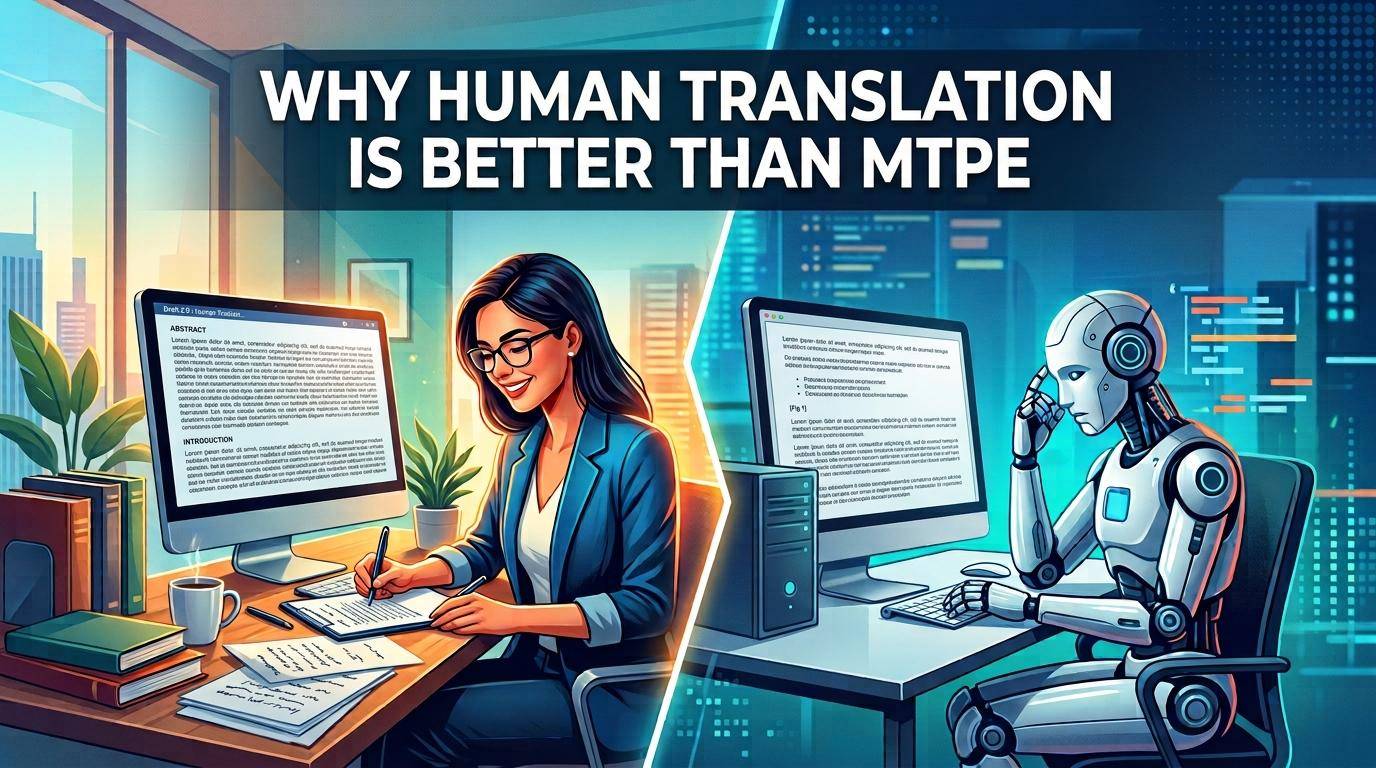
Why Human Translation Is Better Than MTPE
Artificial Intelligence (AI) is influencing every aspect of our lives, and translation is no exception. As organizations realize the limitations of relying solely on automated translations, many are adopting machine translation post-editing (MTPE). That is, AI generates the first draft, and a professional linguist reviews, edits, and corrects it. In practice, this combines the speed and scale of computer-generated translation with the expertise of professional translators. In reality, the best translators often find it easier to start from scratch.
As the well-known business adage states: good, fast, cheap—you can only pick two.
The Problem with Machine Translation Post-Editing (MTPE)
Machine translation post-editing (MTPE) involves a professional linguist checking, editing, and correcting a translation generated by an AI model. There are two primary types of MTPE: light post-editing (LPE) and full post-editing (FPE).
- LPE entails an editor making minor corrections and functional fixes to grammar and mistranslations without polishing the text.
- FPE calls for an editor to revise grammar, style, tone, and terminology while adapting for cultural nuance—ultimately ensuring it reads like the original text.
In general, MTPE translation is better suited to LPE projects. Translators often find that FPE takes more time and is more work than creating a translation from scratch, negating the speed and cost benefits of MTPE.
MTPE Does the Light Lifting
MTPE fails to deliver the speed and cost benefits it promises for a simple reason: it’s good at the easiest part of a translator’s job, but not the complex work that takes time and costs money. A translator working from scratch can more easily capture a source’s nuance, structure, and tone. They make decisions as they move from the text’s beginning to end. Conversely, a skilled translator working with MTPE-created content must work backwards to fix it—generally a less efficient process.
MTPE handles the routine work skilled translators already handle quickly, while the challenging work remains. It also forces linguists to correct instead of craft, which is often slower and yields lower-quality results than translating from scratch.
MTPE Involves Translating Two Texts
What might seem like a quick edit of an AI-generated translation isn’t always the easy fix it appears. In fact, in many cases, it doubles the work. Linguists post-editing machine-generated texts often have to toggle between the source and the translation to decipher the original meaning and intended tone.
When translating a document, linguists make choices about everything from syntax and style to terminology. MTPE changes the linguist’s job from making those decisions to evaluating an algorithm’s. Translators are human. AI translation follows a formula, while people consider numerous factors that an algorithm can miss, such as questioning their own judgement, limiting unnecessary changes, avoiding offense, and standing behind every edit.
Rather than construct a cohesive translation, they must audit AI’s work:
- Is it good?
- Is it bad?
- Is it good enough?
- How heavily should it be edited?
- Does it require a fresh translation?
MTPE isn’t just about adding AI to the translation process; it’s a fundamental shift in how translators work and the skills they need. And it’s not necessarily for the better. A linguist working in an MTPE process must be able to edit an AI-generated translation, but must also be able to craft a translation from scratch when the machine’s output is unusable.
Where MTPE Struggles
Machine-generated translations can miss context, misuse terminology, hallucinate content, and make subtle errors that fluent-sounding text masks. The efficiency of MTPE disappears when editors must repeatedly fix problems that a skilled translator would have avoided in the first place. More so, in high-value communications, a single mistake can carry considerable risk, such as in customer-facing, regulated, specialized, and creative fields. For example:
- Legal documents are rich in jargon, feature complex formatting, and a mistake can shift meaning.
- Medical content is laden with technical terminology and accuracy is essential for safety, health, and well-being.
- Marketing copy—which is commonly rich in nuance, tied to culture, and full of subtle wordplay—translation miscues can hurt brands and damage trust.
Also consider that machine translations are generated using millions and millions of human translations. That’s right, machine translation requires human translation. And if you’re introducing an innovative new product or launching an original marketing campaign, MTPE will likely produce a stale translation based on old text.
The best translators are as much artists as they are linguists. They don’t just translate words—they translate meaning. Can they edit precision into a technical text or creativity into marketing copy? Yes, but not faster or more easily than if they started fresh.
Translations ABC
Translations ABC has been providing high-quality translations for almost 40 years. Over that time, a lot has changed, but one thing remains the same: there’s no replacement for working with a great translation agency and linguist. It’s been our experience that those touting MTPE and other AI-generated translations spend a lot of time talking about speed and scale, but gloss over quality.
Our linguists are fluent speakers who are experts in their field and your copy is too valuable to become AI slop. Contact Translations ABC and see why clients have been choosing and sticking with us for almost four decades.