Smarter Translation: Why AI Isn't the Answer
Artificial intelligence is transforming industries in all fields, and the translation industry is no exception. While the promise of AI is great, the reality is more measured. AI isn’t a magic button you can simply push to solve all your translation challenges, nor is it a replacement for a highly skilled translator.
AI translation is at peak hype—yet a growing number of decision-makers are finding the reality far more uneven. Results swing from impressive to disappointing, leaving many to question whether they are truly better off than they were with human translators alone.
Pressure to Adopt AI Translations
Businesses and organizations face ongoing pressure to increase output, cut costs, and improve efficiencies. On the surface, the use of AI translation tools is appealing—they’re extremely fast, scalable, and deliver near-instant results. It’s easy to see why leaders believe that AI is a simple plug-and-play solution: drop your text in, and get a perfect translation. But just because a translation is readable doesn’t mean it’s reliable.
A fitting analogy for AI translation is the difference between an off-the-rack suit and one crafted by a bespoke tailor. Both are suits—but only one is made to your exact requirements, preferences, and style. The difference shows. AI-generated translations are often serviceable, or even impressive at first glance; however, language is deeply human and shaped by culture, experience, and environment—it’s here that the translator, like the master tailor, demonstrates their value.
5 Reasons Why AI Translations Aren’t the Answer
Thinking of incorporating AI into your translation process? Below are some challenges you may face and why you should consider working with a human translator.
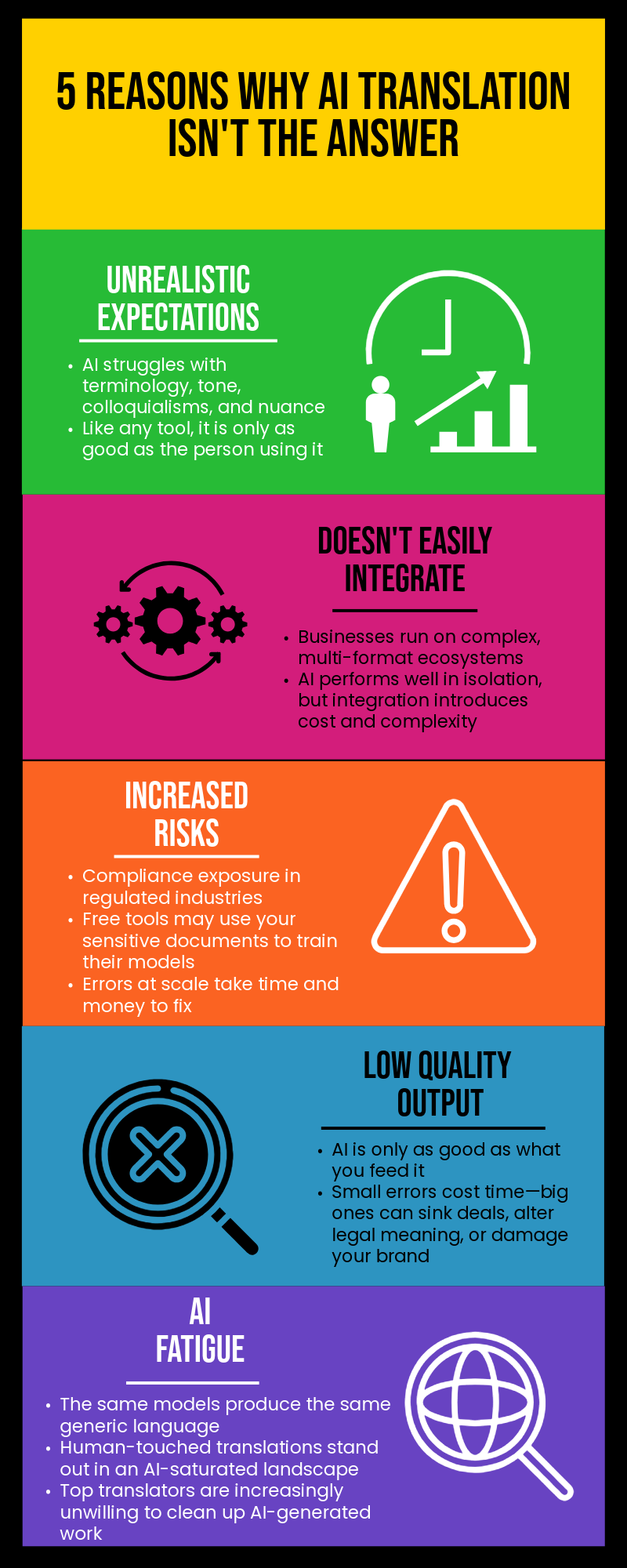
1. Unrealistic Expectations
The best translation agencies and translators provide benefits that many leaders miss at first glance. Even the strongest AI-generated translations struggle with industry-specific terminology, colloquialisms, tone, and nuance. They can also generate hallucinations—that is, false or misleading information.
What decision makers overlook is that AI is like any other business tool—no different than a spreadsheet, database, or CRM. In the right hands, it delivers remarkable results. In the wrong ones, it falls short. The technology isn’t a replacement for translators, but a powerful instrument deployed where the work demands it.
2. Doesn’t Easily Integrate
The amount of technology used in the workplace today is staggering. Businesses and organizations rely on an ever-expanding ecosystem of web platforms, customer management systems, project management software, and design tools—not to mention files spanning every format imaginable, from PDFs and Word documents to spreadsheets and presentations.
AI tools often perform well in isolation, but integrating them across systems and formats introduces complexity that can erode efficiency and create unforeseen challenges. This can carry real costs—eating into productivity and savings alike—and can narrow the gap between machine-generated translation and skilled human translators more than decision-makers might expect.
The perceived AI advantage further shrinks when factoring in the deeper ROI that experienced translators deliver.
3. Introduces Additional Risk
AI makes mistakes, and AI errors come at a cost. In highly regulated industries such as healthcare and legal services, AI translation carries significant compliance risk—from HIPAA violations to breaches of attorney-client privilege.
Beyond compliance, there is the equally pressing question of data security. Many free AI translation tools use the content you upload to train their models—meaning sensitive documents may be feeding the very systems you are trusting to handle them.
On a more basic level, the speed of AI translations has also introduced errors at scale. This takes time and money to correct. It also once again closes the margin between machine and human translation. In fact, our experience has shown that it’s often easier to create a human translation than fix an AI translation.
More importantly, experienced translators ask questions and flag potential problems during the translation process, helping ensure a smooth, issue-free final product. And if something does go wrong, there’s someone accountable.
4. Low-Quality Work
The quality of translations has long relied on the quality of the source material—flawed inputs result in flawed outputs. AI exacerbates this problem. Unlike knowledgeable translators who think critically about the source material and the target language, AI is dependent on what we feed it. Inputting source content lacking clarity and consistency into an AI translation tool leads to subpar results.
This is another instance where AI performs well in isolation. Translate a single sentence and you’ll often get a perfectly acceptable result. But scale that to a paragraph or an entire document and the cracks begin to show. Individual translations may be accurate, but the larger message—the thread that runs through the whole—gets lost. Examine it more closely, and what initially looked satisfactory is riddled with small issues.
In the best case, these small problems cost a human translator time and money to fix. But, in the worst case, a mistranslation can change the meaning of a legal document, sink a deal, or damage your brand—causing real and lasting harm.
5. AI Fatigue
As AI continues to make inroads across industries, the same models—and ultimately the same generic language—are being used by everyone. Messaging and translations that incorporate a human touch stand out in a landscape increasingly saturated with AI-generated content.
It’s not just end users who are growing tired of AI content. Top translators are generally not interested in editing AI-generated translations. In other words, relying on AI can make it harder to secure top talent.
Translations ABC
For close to four decades, Translations ABC has been delivering premium translation services to industries ranging from business to engineering to healthcare. While technology has always played a role in our process, we’re proudly a human-driven organization, with translations done by real people, who are fluent in both source and target languages and experts in their field.
That uniquely human touch extends to how we treat our customers. Over our 37 years in business, Translations ABC has developed a reputation for stellar customer service and being not just a service provider, but rather a partner who takes pride in every project.
While the false promise of AI garners and creates buzz, smart businesses and organizations continue to trust Translations ABC to deliver accurate, culturally correct, and carefully constructed translations—in the end, keeping pace if not outpacing our machine-driven competition.